How to query all the overlapped meshes in massive animating meshes?

Hi guys, I am trying to query all the overlapped meshes in massive meshes(maybe 10000 or more), then change their materials.

First, i imported three-mesh-bvh and generated meshes.

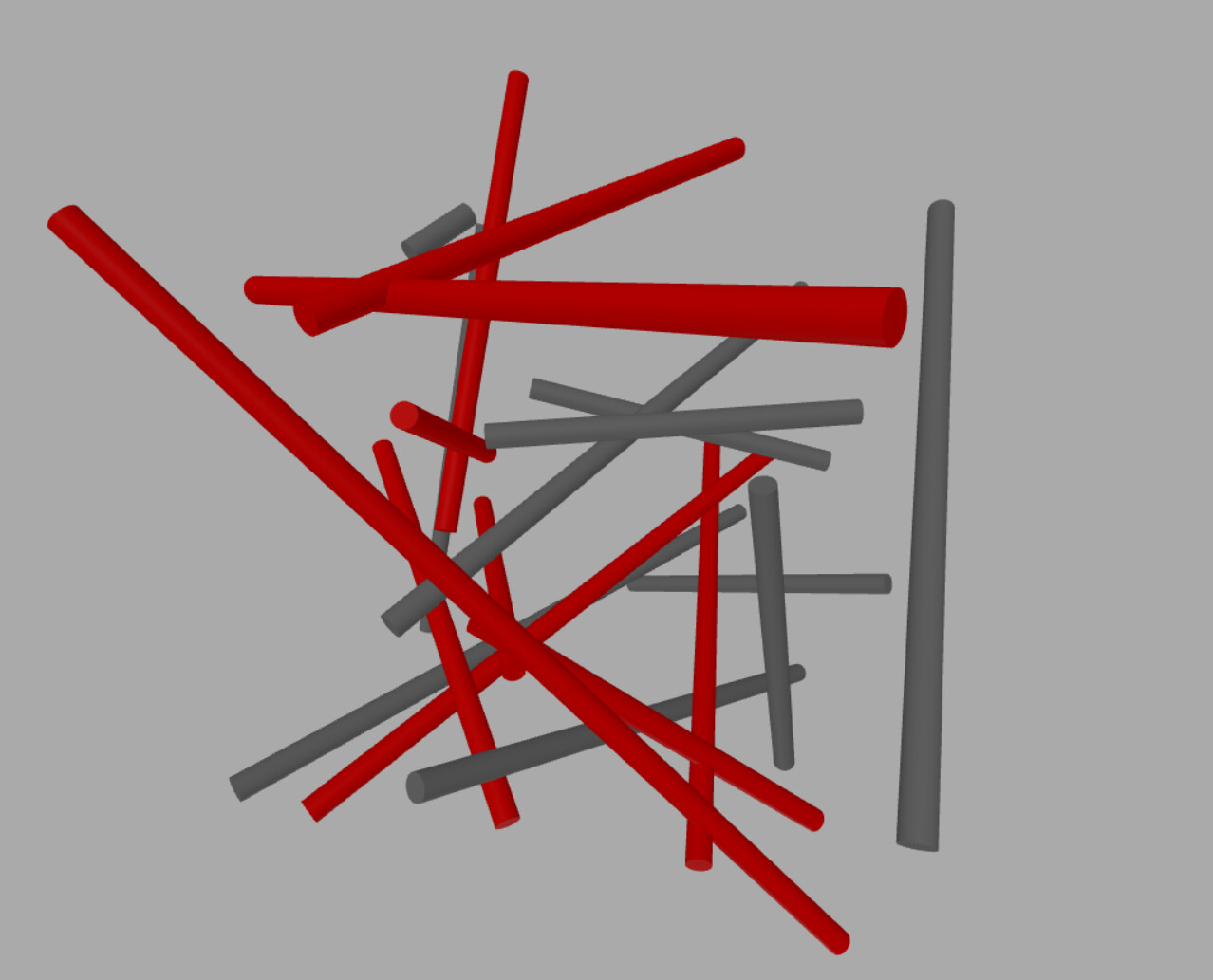
Then i made these meshes animate and queried overlapped meshes in each frame.Here is the code and picture.

const animate = () => {
    renderer.render(scene, camera);

    // query overlapped meshes
    const _overlappedMeshes= [];

    allMeshes.forEach((mesh1) => {
        let isOverlapped = false;

        for (let i = 0; i < allMeshes.length; i++) {
            const mesh2 = allMeshes[i];
            if (mesh1 === mesh2) continue;

            const transformMatrix =
                new THREE.Matrix4()
                    .copy(mesh1.matrixWorld).invert()
                    .multiply(mesh2.matrixWorld);

            const hit = mesh1.geometry.boundsTree?.intersectsGeometry(
                mesh2.geometry,
                transformMatrix
            );

            if (hit) {
                isOverlapped = true;
                break;
            }
        }

        if (isOverlapped) {
            // change material
        }
    });
}

renderer.setAnimationLoop(animate);

Finally, i found that when the count of meshes increased, fps became slow because the double loop of querying consumed too much.

So how can i improve this scene?

Here are a few simple ideas (I have used them in a project that checks closeness of tens of thousands of moving objects):

  • remove everything that can be moved outside the loop (e.g. in the loop you create Matrix4, but it could be created once and then reused)
  • reduce the computations inside the loop (e.g. matrix inversion and multiplications are CPU-heavy operations – do you always need them)
  • add some quick tests (e.g. if objects are too far from each other, there is no need to check them)
  • use the fact that collisions are symmetrical, if A collides with B, then B also collides with A – this can reduce the checks by 50%
  • you may distribute collision test along the time, e.g. one frame you test the first 1000 objects, the next frame you test the next 1000 objects and so on

And here are some more complex ideas:

  • tailor the checks to the shapes – e.g. if you have only thin and long cylinders, you can check the distance between the lines along the cylinders and only if it is too small, then continue with the other checks
  • use physics engine with optimized collision tests
  • move the collision check to a webworker
  • move the collision check to the GPU

As I have never needed to use BVH, there might be some functionality in three-mesh-bvh that makes such tests faster, as it is the nature of BVH to split space into subspaces and achieve time complexity lower than O(n^2). So I hope someone will join the discussion and provide more useful advices.
1 Like

Thank you! Your ideas are really helpful.

I also seached the examples and issues in three-mesh-bvh repo but found nothing familiar.

If i missed any API in three-mesh-bvh, i would greatly appreciate it if someone could remind me :slight_smile: