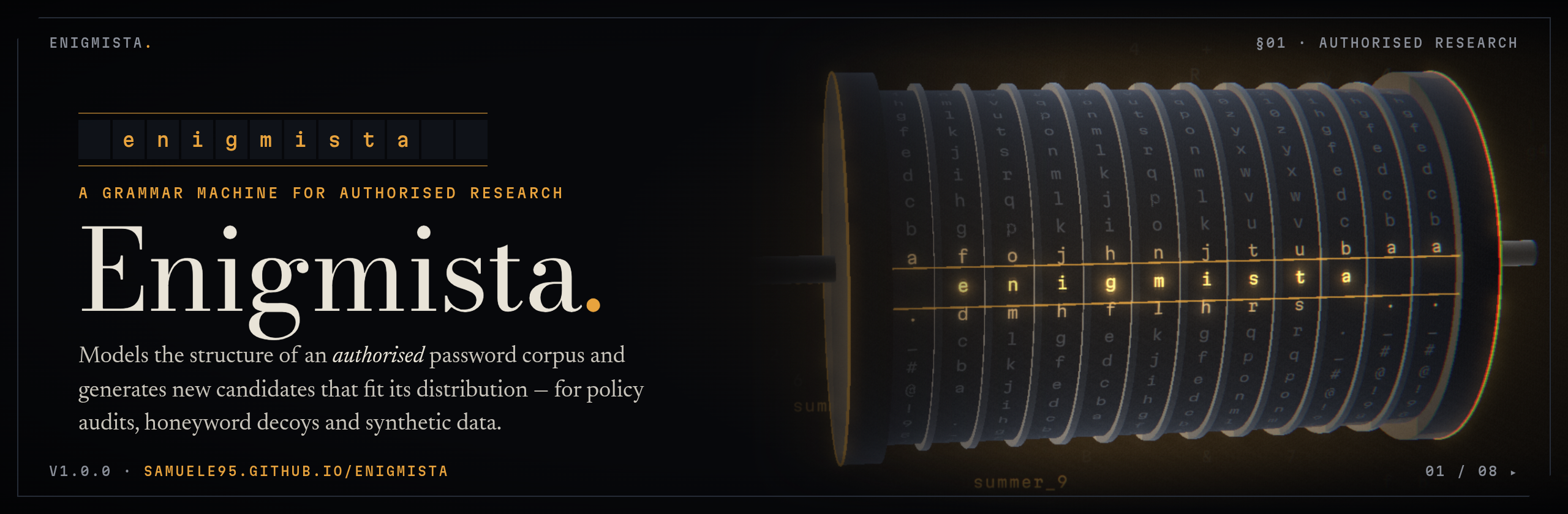
Live: samuele95.github.io/enigmista · Code (MIT): github.com/Samuele95/enigmista
What Enigmista does: it generates passwords from a corpus of passwords you already have. It learns the corpus’s structure as a probabilistic grammar (the templates people use, and the words, years, digits and symbols that fill them), then samples new, previously-unseen passwords with the same distribution. It’s scored on how many real passwords from a held-out part of the same corpus it manages to generate. Typical uses: testing a password policy, making honeyword decoys, building synthetic datasets. It only works from a corpus you’re authorised to use, and never targets a person.
This is its release website, told as a short film: one wheel flick = one beat, and every caption is dialled first on the Rotor, a cryptex of 12 glyph discs. The text only writes itself once the discs lock.
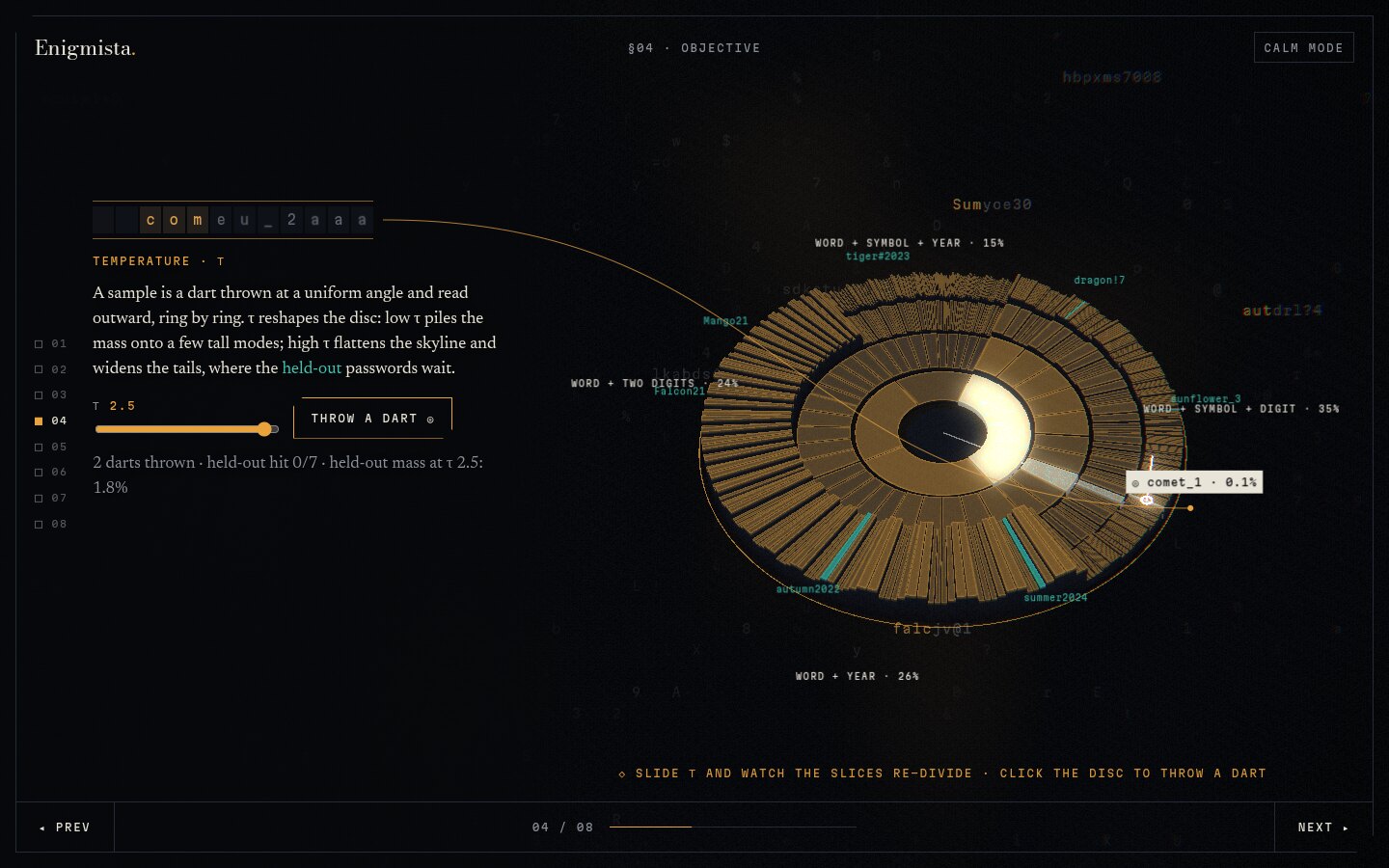
Bits that might interest you here
- One canvas, three layers. A full-screen glyph field (orthographic, DataTexture-driven cells over a canvas-built glyph atlas, one draw call at a 24 fps film cadence). The perspective world composited on top. Then a small custom post chain: threshold → one reusable 9-tap blur at ¼ and ⅛ res → a film pass with glow, edge chromatic aberration, vignette, grain, and a “cipher glitch” (horizontal band slips) driven by camera travel. The whole pipeline stays in raw display values, so a hex in CSS is the hex on screen.
- The Rotor. 12 discs × 42 glyphs in a single instanced mesh. Per-ring angle, velocity and state uniforms. Motion blur along the rim in the fragment shader while a disc spins. After a camera flight the discs click home on a critically damped spring, substepped on real time so it settles identically at 60 fps or 8.
- The probability disc. The toy grammar drawn as a 3D sunburst of 924 instanced sector prisms, each shaped in the vertex shader from (a₀, a₁, r₀, r₁, h). Ring 0 = templates, outer rings = slot terms. Every slice’s angle is the sampler’s own tempered conditional share p^(1/τ), so a dart thrown at a uniform angle and read outward is inverse-CDF sampling. τ re-divides every slice live, tower height ∝ √mass, and held-out passwords stand in teal. Hover picking marches the ray down through height planes so a tall tower wins over the floor behind it.
- Framing that can’t collide with text. Every caption beat is a camera shot fitted exactly into a CSS-reserved visual frame: for each point of the subject, the distance at which it projects just inside the box, in the camera’s basis, plus a view offset. A headless Puppeteer sweep checks all 33 beats × 8 viewports that no caption ever sits over the 3D. It also pages through the whole film with real wheel/key input.
- DOM ↔ drum. Each caption opens with 12 cells mirroring the drum’s front row live (blurred while spinning, ember on lock). An SVG tether follows the projected source: the reading row, a branch tip, the loop station, or the dart on the disc.
- Calm mode.
prefers-reduced-motion(or one click) turns the film into a plain scrolling document. No WebGL world, and the check measures 0 animation frames per second.
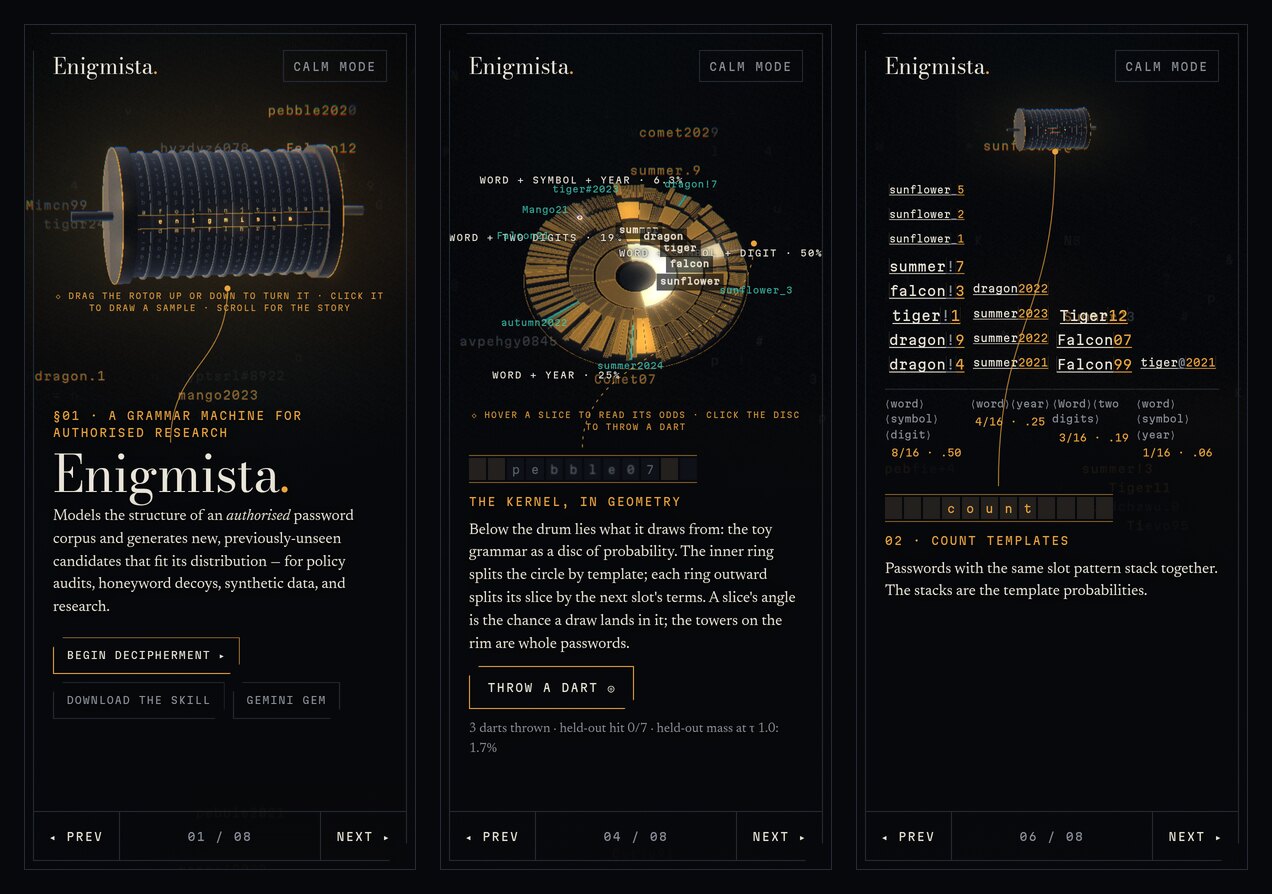
Stack: Vite + three r186, hand-written GLSL, no animation library. The film’s playhead is a few hundred lines of vanilla JS. Fonts self-hosted, no analytics or trackers, static on GitHub Pages. The in-page sandbox only ever uses a bundled list of 16 obviously fake passwords and has no text input anywhere.
Feedback very welcome, especially on performance on real hardware.